

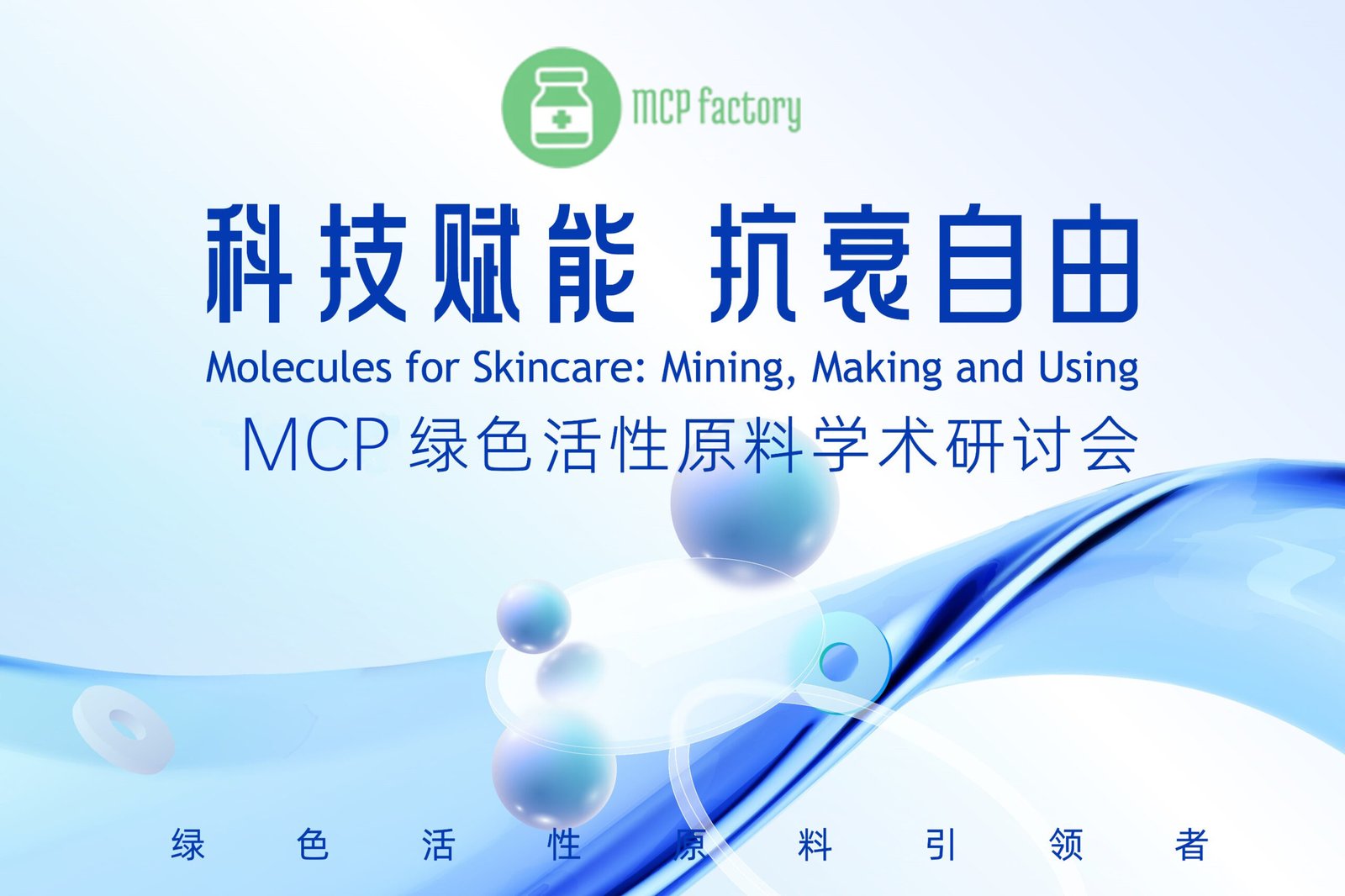
On July 22nd, the “Science and Technology Empowering Anti-Aging Freedom” Green Active Raw Material Academic Seminar, hosted by Guangzhou Enzyme Products Biotechnology Co., Ltd., co-organized by Huibai Biotechnology Co., Ltd., and with media cooperation from Peptide Research Society, Root of C, and Cosmetics Observation, was held. This conference brought together renowned industry experts, university professors, and overseas-returned PhDs from home and abroad to share valuable insights, revealing the scientific stories behind effective raw materials; and jointly exploring the certainty of industry growth from the perspectives of the creation, synthesis, and application of effective raw materials.
Before the conference began, Dr. Xing Jijun, Chairman of the International Cooperation and Science and Technology Diplomacy Committee of the China Association for Science and Technology Policy Research and former Director-General of the Chinese Consulate General in New York, delivered a speech, saying: “It is a great honor to participate in such a grand event as a guest speaker. Today, we gather here to discuss the technological development and products related to ‘synthetic biology,’ a cutting-edge and highly complex discipline. It’s hard to imagine that more than 40 years ago, this was just a small fishing village, which illustrates that we live in a changing world, a changing era, and we are creating history. Shenzhen, as one of the world’s most innovative cities, has achieved remarkable results in various scientific and technological fields, all of which are the fruits of reform and opening up. Through reform, we have improved efficiency and increased vitality; through opening up, we have broadened our horizons and enhanced our dynamism. In the past week, the Third Plenary Session of the 20th CPC Central Committee just concluded, with the theme of further comprehensively deepening reform. Faced with the complex international situation, a new round of technological revolution and industrial transformation, and the new expectations of the people, we can only respond to all changes and achieve steady and long-term progress by further comprehensively deepening reform.”
Keynote speech
A chemical and interdisciplinary eye to solve synthetic challenges ofcarbonhydrates
Professor David Bonnaffe of the University of Paris-Salec, France, and President of Eurocarb 2023 (European Sugar Society), was invited to deliver an academic report on sugar chemistry, revealing the latest developments in the field. Professor Bonnaffe showcased a series of research achievements by his research group in sugar chemistry, leading us to understand the development process and scientific story behind the star active ingredient, xylose derivative Bosein.
From the Lubineau reaction to BOXIN—Green synthesis as a source of sustainable innovation in the cosmetics industry.
Dr. Lu Yunyu, founder of Huibai Bio and chief scientist of Best Biotech, was invited to deliver a keynote speech. Dr. Lu first introduced the strategic partnership between Huibai, Best Biotech, and Enzyme Products with Prof. David Bonnaffe and the European Sugar Society. Dr. Lu is a direct disciple of Prof. David Bonnaffe and the inheritor of the BOXY synthesis technology. He further explained the methodological basis of BOXY synthesis—the revolutionary Lubineau reaction: “Synthesizing carbon glycosides under aqueous conditions not only simplifies the synthesis steps of BOXY but also realizes a green production method for BOXY for the first time, solving the environmental problems faced by traditional chemical methods. This reaction is not only simple and effective but also highly applicable to industry. Its core advantage is that it can perform carbon glycosylation without protecting groups and can make the carbon chain larger, thus making it easier to generate derivatives.” Dr. Lu then explained why the original research company, after discovering that the pure S-configuration BOXY was better, still did not synthesize a single configuration of BOXY and systematically elaborated on the process iteration driven by the concept of green chemistry.
From Bosein to Green Carnosine: Scenario-based Applications of Enzyme-Directed Evolution Technology
Dr. Huang Hua, Chief Scientist of Enzyme Products and a researcher at South China University of Technology, delivered a keynote report. Dr. Huang began by introducing the material transformation and evolutionary capabilities of enzymes from a life science perspective. Enzymes have wide and flexible applications, demonstrating enormous potential both in vitro and in vivo. Starting from the underlying logic of biomanufacturing and application, he demonstrated the construction logic and process of the Enzyme Products biotechnology platform, and then shared the product development approach of Enzyme Products based on this platform: “When discussing the project development practice of Enzyme Products, we can first simply identify a product, then design the enzyme transformation route based on the product. After setting it up, we find many enzymes with potential catalytic activity in the gene library. Often, this enzyme cannot meet our actual application needs, so it must be modified to improve its performance, including its thermal stability, catalytic concentration, etc. After meeting the standards, production can begin, starting with fermentation production, followed by catalytic application. This process achieves optimization and iteration through continuous cycles of design, construction, testing, and learning.” Dr. Huang showcased the patented technologies and practical achievements of Enzyme Products in the field of directed enzyme evolution through practical examples such as S-Bosoxane, green carnosine, and dipeptide libraries.
IT for Beauty — An Innovative Intelligent Raw Material Discovery Platform System
Shou Chongbo, Vice President of Enzyme Product Digitalization and Senior Scientist, delivered a report. Dr. Shou Chong began by discussing the entire process of innovative drug development, using examples such as Moderna and Halicin to illustrate the trend of BT (biotechnology) and IT (information technology) collaboratively driving the development of the “biologically targeted” era: “We believe that the future development direction of the pharmaceutical industry is ‘biologically targeted,’ which is consistent with the development direction of the cosmetics industry. From preclinical research, including the initial gene target library and literature database, to bioinformatics analysis, therapeutic target screening, compound library, cheminformatics screening and analysis, and then to high-throughput screening and computer-aided drug discovery, all are the results of the combination of BT and IT technologies. This achievement has greatly improved the efficiency of new drug development, and it can also be transferred to the cosmetics industry to accelerate our new raw material development process.” Subsequently, Dr. Shou Chong launched the R-IMP Innovative Raw Material Intelligent Discovery Platform for Enzyme Products for the first time. This platform is dedicated to the development of First-in-Class innovative active raw materials. Combining advanced algorithms such as molecular dynamics AI and bioinformatics, it integrates large-scale databases such as target genes, multi-omics, oligopeptides, natural peptides, and protein structures, significantly accelerating the development of innovative raw materials. From systematic screening of raw materials and data analysis to experimental verification, the R-IMP platform has not only revolutionized the traditional raw material development model, but also expanded the innovation boundaries of cosmetic raw materials.
Beauty Enhanced by Peptides: The Creation and Development of New Cosmetic Raw Materials Using Computer-Aided Technology
Dr. Jiazhong Li, Vice President and Senior Scientist of Enzyme Products’ Biocomputing division, delivered a keynote speech. Dr. Li first introduced the logic behind computer-aided creation of cosmetic raw materials, explaining the crucial role of computer-aided and AI technologies in the raw material development process: “Our so-called ‘IT for beauty’ is essentially about discovering new raw materials with clearly defined targets. Taking whitening efficacy as an example, we can screen for α-MSH structural analogs targeting MC1R to inhibit its effects; another key target is tyrosinase, and we can screen for TYR inhibitors. Enzyme Products’ computer-aided creation of new cosmetic raw materials covers five dimensions: identification of natural active ingredients, screening of active raw materials based on target proteins, structural optimization of raw materials with known efficacy, efficacy mechanism research, and synthetic biotechnology production of effective skincare raw materials. By combining computer-aided screening with efficacy experimental methods, we can easily verify the efficacy and performance of raw materials and develop a series of potent and safe new raw materials.” Using S-pros-Xylane, whitening raw materials, and collagen tripeptides as examples, Dr. Li showcased Enzyme Products’ practical achievements in computer-aided new raw material development.
From reductionism to systems theory: the contextualization of effective skincare
Dr. Fang Xin, Vice President of Enzyme Products and Senior Scientist, delivered a keynote speech. Dr. Fang began by comprehensively analyzing the symptoms and processes of skin aging from the perspectives of biology, chemistry, and materials science, providing a systematic interpretation of the underlying logic of technological skincare: “To fully and systematically understand aging, we must recognize that it is not the result of a single factor following a specific linear deduction. It involves many factors, and these factors have a complex interaction process. Therefore, from a systemic perspective, aging is actually a dynamic network composed of multiple complex factors interacting. Why understand aging from a systemic perspective? Because a systemic perspective is closer to the true process of aging and can help us provide solutions from a holistic, multi-dimensional perspective, and design skincare products more scientifically.” Dr. Fang comprehensively elaborated on the application of peptide raw materials in the field of functional skincare, introducing new ideas for raw material development and creation from different dimensions such as natural peptides, peptide derivatives, and structural analogs. She also demonstrated the numerous advantages of the “Three Factors Eighteen Peptides” holistic functional skincare solution from Enzyme Products, using specific examples.
Efficacy skincare formula solutions
At this conference, we have specially prepared a formulation solutions zone to fully showcase our professional support capabilities across the entire chain, from raw materials to formulation application, efficacy and safety evaluation.
Technology empowers, anti-aging freedom! The 2024 Symposium on Green Active Raw Materials for Enzyme Products was successfully held.
We look forward to seeing you again next time!
For more presentations, please continue to follow the enzyme product video account.