

Recently, collaborative research by enzyme product scientist Dr. Huang Hua revealed a novel ergothioneine oxidation metabolic pathway, and the relevant research results were published in the internationally renowned bioscience journal Biochemical and Biophysical Research Communications.
This enzyme-based collaborative study revealed a novel ergothioneine oxidative metabolic pathway. In this process, Actinobacteria first oxidize ergothioneine to ergot-sulfinate using a dioxygenase (PF05995). The sulfinate is then catalyzed by a metal-dependent ammonia hydrolase (SF51556) to sulfinic acid and hercynine. Hercynine is then converted by an amine lyase (HAL, PF00221) to release trimethylamine and urocanate. Finally, urocanate enters the classic L-histidine metabolic network. This study further demonstrates the diverse metabolic pathways of ergothioneine in nature.
1. Brief background introduction of Erg
L-Ergothioneine is a powerful, natural antioxidant and a key active ingredient in various mushrooms, such as oyster mushrooms and button mushrooms. Due to its wide distribution, strong antioxidant properties, and high safety, ergothioneine is not only abundantly absorbed and accumulated in nature by various plants and mammals, but also accumulates in large quantities in various organs of the human body (such as red blood cells, bone marrow, and cornea) through specific transport proteins (Ref 1: see our previous JACS ergothioneine post). In practical applications, ergothioneine has long been recognized as safe by the European Food Safety Authority (EFSA) and the US Food and Drug Administration (FDA), and is now widely used in diets with high safety requirements, such as food additives for infants and pregnant women. Furthermore, with in-depth research into the metabolic mechanism of ergothioneine in the human body, we have gradually discovered that ergothioneine not only has the well-known antioxidant function, but also that human cells and intestinal bacteria can break down ergothioneine to release two very important small molecules, H2S and trimethylamine (TMA), which are known to be important (Ref: 2-3). H2S can balance and regulate various related physiological activities in the human body. Ergothioneine exhibits various physicotropic, pro-inflammatory, and anti-inflammatory activities, as well as pro-apoptotic and anti-apoptotic activities. Recent reports indicate that the H2S molecule can promote NAD+ concentration increases, thereby delaying aging. Trace amounts of trimethylamine (TMA) in the human body can enter the circulatory system and be oxidized in the liver to trimethylamine N-oxide (TMAO), a compound with cellular and blood-brain barrier protective effects (Ref: 4-6). It is foreseeable that with further research on ergothioneine, we will gain a more comprehensive and in-depth understanding of the mechanism of action of this century-old molecule in the human body.
2. Research Content—Revealing the Oxidative Metabolism of Ergothionein
This study began by using an “enzymomics” strategy to explore substrate differences among members of the cysteine dioxygenase (PF05995) family. Systematic analysis of the gene background of this enzyme family revealed high adjacency between some dioxygenase members (Uniprot ID: I0HBI6, U5W0W6, A0A327Z5R8) and amine lyases (HAL, PF00221). Subsequent experimental testing showed that this amine lyase (Uniprot ID: I0HBI5, A0A428XHP4, A0A0U3R9K0, A0A1M3PJT1)… The cysteine dioxygenase (A0A429B4Z1) can efficiently cleave trimethylhistidine (a metabolic intermediate in the ergothioneine synthesis and degradation pathway) into trimethylamine and uric acid. Therefore, it is speculated that the substrate catalyzed by this cysteine dioxygenase is related to ergothioneine. Finally, in vitro activity tests showed that this dioxygenase can oxidize ergothioneine into an unstable ergothioneine sulfinate (Erg-sulfinate). In subsequent metabolism, ergothioneine sulfinate can be spontaneously oxidized to ergothioneine sulfonate (Erg-sulfonate) under the action of oxygen, and then enter the catabolic metabolism involving the known OCD enzyme family (Ref 7, tweet from ACS catalysis). On the other hand, it can be directly degraded into sulfinic acid and trimethylhistidine by a metal-dependent hydrolase (Uniprot ID: I0HBI7, A0A327Z2J9, SSF51556) adjacent to this dioxygenase gene (Figure I). This study not only demonstrates once again the effectiveness of enzymomics strategies in microbial metabolism research and showcases the diversity of substrates catalyzed by the cysteine dioxygenase family, but also further expands the understanding of the metabolic variability of ergothionein in nature.
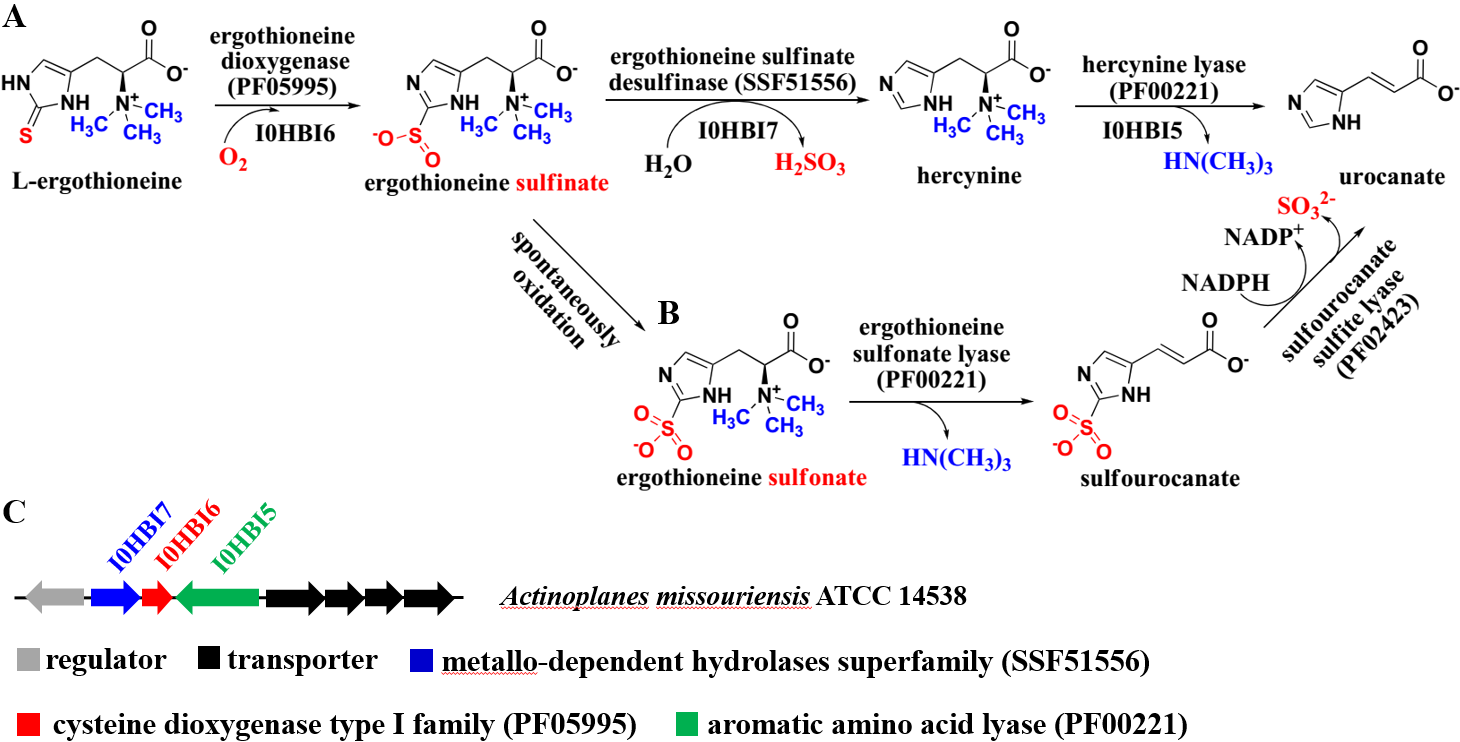
Figure 1: The ergothionein oxidative catabolism pathway in * Actinoplanes missouriensis * revealed in this study .
3. Regarding finished enzyme products
Enzyme Products is committed to becoming a global leader in green active ingredients . Utilizing next-generation synthetic biology technology, Enzyme Products focuses on the green production of bioactive ingredients such as peptides, proteins, sugars, nucleic acids, and lipids. Leveraging over 20 years of research and industry experience from its founding team, the company has established a leading multidisciplinary technology platform in China. It has achieved large-scale production of dozens of green active ingredients, including Smegglutinin, S-Pros-Xylane, Ergothioneine, Ectoin, Collagen Tripeptide, Human Milk Oligosaccharides, Ceramides, NAD+, NMN, Copper Peptide, Carnosine, Glutathione, and Rhodiola Rosea glycoside. The company has cumulatively provided high-quality green active ingredients to over 2,000 well-known companies in the fields of functional skincare, biomedicine, nutrition and health, and animal nutrition .
The company ranks among the top international companies in terms of R&D investment, scale, and output value. It has undertaken multiple key provincial and municipal R&D projects, applied for more than 200 invention patents, and received more than ten national and local titles, including National Specialized, Refined, and Innovative Small Giant Enterprise, National High-tech Enterprise, Guangdong Provincial Postdoctoral Innovation Practice Base, Shenzhen Overseas High-level Talent Team, Shenzhen Potential Unicorn Enterprise, Zhuhai Innovation and Entrepreneurship Team, and Gansu Provincial Specialized, Refined, and Innovative Small and Medium-sized Enterprise. It has also been recognized as one of the Top 100 Future Unicorns in China in 2025, one of Deloitte China’s Top 50 High-Tech High-Growth Enterprises in 2024, one of Deloitte Shenzhen’s Top 20 High-Tech High-Growth Enterprises in 2024, the Harvard Business Review High-Energy Innovation Team Award in 2023, and one of Shenzhen’s Top 100 High-Growth Enterprises in 2022.
References :
[1] The enzyme product was developed in collaboration with South China Normal University, and the research results were published in JACS.
[2] Petrovic et al., Cell Metab. 2025, 37, 542–556;
[3] Chenxi Feng, et al. J. Am. Chem. Soc., 2025,147,1, 257-264;
[4] Simó C., et al. Food Funct. 2020, 11, 6745–76;
[5] Hoyles L., et al. Microbiome 2021, 9, 235;
[6] Giuseppe C., et al. Physiol Rev. 2023, 103, 31–276;
[7] Qiongxiang Yan, et al. ACS Catal. 2022, 12, 4825−4832.