

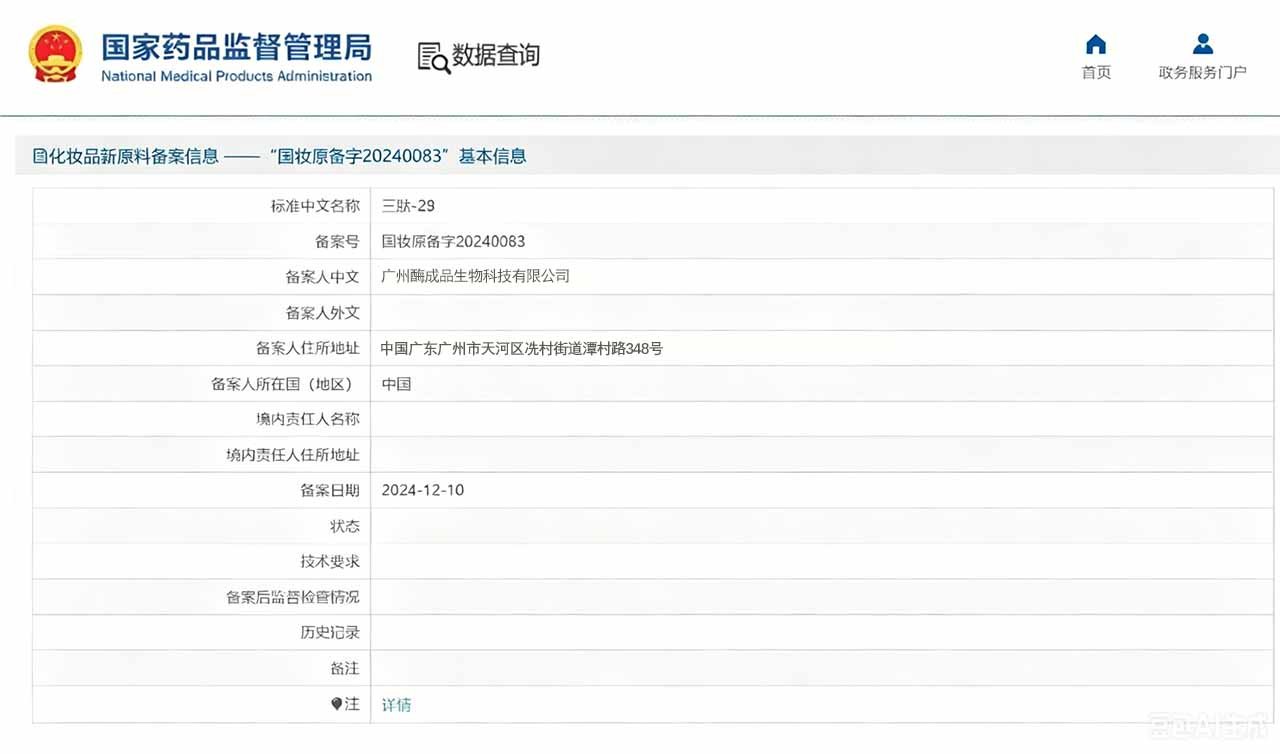
Recently, Enzyme Products completed the registration of collagen tripeptide (INCI name: tripeptide-29) as a new cosmetic ingredient (National Cosmetic Ingredient Registration No. 20240083) . Collagen tripeptide is Enzyme Products’ second innovative peptide ingredient following the registration of acetylcarnosine as a new cosmetic ingredient in May 2023. This breakthrough signifies Enzyme Products’ continuous innovation in the field of green active ingredient creation, laying a solid foundation for the company’s own development and bringing more innovative opportunities to the industry.
1. Collagen and collagen tripeptides
As a major component of the skin, collagen accounts for approximately 75% of its dry weight and primarily functions to support the skin and maintain its elasticity. There are five main types of collagen in the skin: type I, type III, type IV, type VII, and type XVII. Type I and type III are the most abundant, mainly located in the dermis, where they provide support. Types IV, VII, and XVII collagen are mainly found in the epidermal-dermal junction, acting as bridges in the skin’s structure, connecting the epidermis and dermis, and maintaining the skin’s integrity and elasticity.
Collagen possesses high bioactivity, accelerating cell proliferation and differentiation, promoting tissue repair and wound healing, and is widely used in wound repair products. Through research on collagen sequences, a series of cosmetic peptides with smaller molecular weights, better transdermal effects, and anti-aging and repair properties have been developed, such as palmitoyl pentapeptide-4 from type I collagen fragments and hexapeptide-9 from type XVII collagen fragments.
The development of cosmetic peptides stems from research into the skin damage repair process. When the skin is injured, the collagen structure is damaged, producing short peptide fragments. These short peptide fragments bind to cell surface receptors, promoting the activation and migration of fibroblasts, promoting the synthesis of related collagen, inhibiting the release of inflammatory mediators, and accelerating tissue repair and remodeling.
The three most abundant amino acids in collagen are glycine (Gly), proline (Pro), and hydroxyproline (Hyp). Hydroxyproline is an important amino acid in collagen and is crucial for the formation of its triple helix structure. The hydroxyl group on hydroxyproline can form hydrogen bonds with other hydrogen atoms in the collagen triple helix structure, enhancing the stability of the collagen structure.
Collagen tripeptides, composed of glycine, proline, and hydroxyproline (Gly-Pro-Hyp), are the most frequently repeated sequences in collagen, accounting for over 10% . They are also crucial for maintaining the triple helix structure and strength of collagen . Due to their small molecular size (285 Daltons), collagen tripeptides are more easily absorbed transdermally compared to larger collagen molecules and collagen peptides . Orally administered collagen tripeptides can be rapidly absorbed via the active transport mechanism of the small intestinal mucosa, directly entering the bloodstream and being transported to the skin. Studies have shown that collagen tripeptides can enter the body in their complete peptide chain form, promoting collagen synthesis.
Currently, the main production method for collagen tripeptides is enzymatic hydrolysis: using fish skin, pig skin, etc., as raw materials, enzymatic hydrolysis breaks down large collagen molecules into smaller, shorter collagen peptides. Collagen tripeptides produced through this method have been used in the oral cosmetic field. However, while this method is simple, animal-derived raw materials inevitably contain allergens, affecting their subsequent use; furthermore, this method yields a mixture of various short peptides with a very low content of actually active tripeptides. Therefore, in certain special applications requiring the addition of highly active tripeptides, collagen tripeptides produced in this way cannot meet the requirements.
To identify the most effective collagen fragments, the enzyme product utilizes its self-developed AI-assisted raw material screening platform, RIMP, to systematically screen collagen fragments of different lengths, followed by efficacy verification of the target fragments. After multiple rounds of screening and analysis, the enzyme product successfully identified the optimal fragment, Gly-Pro-Hyp, among numerous active collagen fragments and developed a collagen tripeptide with multiple benefits, suitable for applications in functional skincare and nutritional health .
Collagen tripeptides offer the following advantages when used in functional skincare products:
(1) The high-frequency tripeptide sequence derived from collagen conforms to consumers’ cognitive habits of anti-aging ingredients and can quickly enter the minds of customers by leveraging the cognitive advantages of collagen and peptides in anti-aging effects.
(2) According to third-party human efficacy experiments, it has good firming, moisturizing and soothing effects. It can significantly improve skin firmness, increase the moisture content of the stratum corneum and relieve skin redness in 14 days.
(3) Collagen tripeptide has good solubility, stability and compatibility. It can be used in conjunction with a variety of raw materials such as S -Bosein and NAD+, while promoting the generation of a variety of extracellular matrix components such as collagen, elastin and glycosaminoglycans, and systematically improving the skin condition.
2. Regarding finished enzyme products
Enzyme Products is committed to becoming a global leader in green active ingredients , employing next-generation synthetic biology technologies to focus on the green production of active ingredients such as peptides, proteins, sugars, and nucleic acids. Leveraging over 20 years of research and industry experience accumulated by its founding team, the company has established a leading multidisciplinary technology platform in China. It has now achieved mass production of dozens of green active ingredients, including Smegglutinin, Telborpeptide, S -Pros-Xylane, NAD+, Blue Copper Peptide, HMOs, and various peptides. It has cumulatively provided high-quality green active ingredients to over a thousand well-known companies in the fields of biopharmaceuticals, functional skincare, nutritional health, and pet and animal health .
After seven years of rapid development, the company has achieved a leading position among global companies in terms of R&D investment, scale, and output. It has applied for more than 150 invention patents and has received more than ten national and local titles, including National Specialized and Innovative Small Giant, National High-tech Enterprise, Shenzhen Specialized and Innovative Small and Medium Enterprise, Shenzhen Potential Unicorn Enterprise, Guangdong Postdoctoral Innovation Practice Base, Shenzhen Top 30 Medical and Health Innovation Team, Zhuhai Innovation and Entrepreneurship Team, and Gansu Specialized and Innovative Small and Medium Enterprise. In 2022, it was selected as one of Shenzhen’s Top 100 High-Growth Enterprises (ranked first among unlisted biotech companies), in 2023 it was selected as a Harvard Business Review High-Energy Innovation Team, and in 2024 it was selected as one of Deloitte Shenzhen’s Top 20 High-Tech High-Growth Enterprises.